Diamond Stud Earrings Buying Guide: Carat Weight, the 4Cs, Settings and Backs

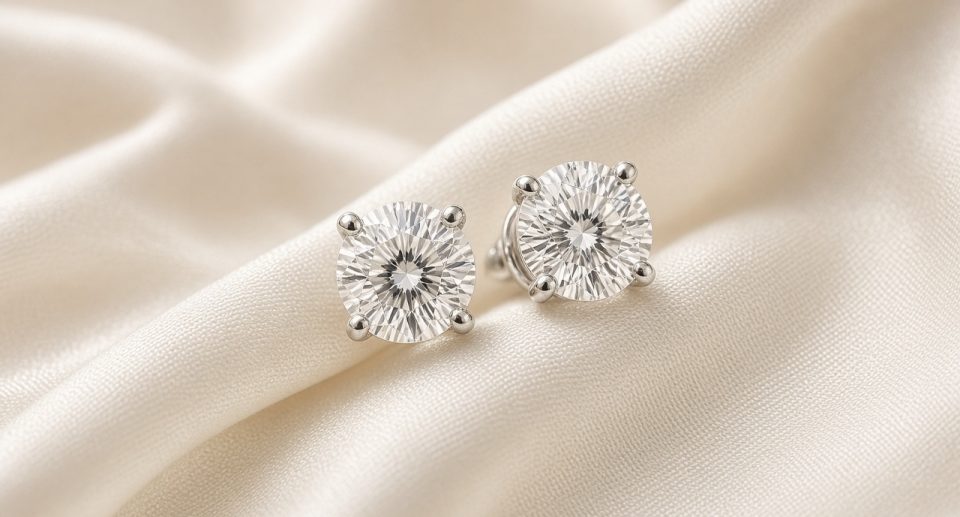

If there is one piece of fine jewelry that belongs in every collection, it is a pair of diamond stud earrings. They work with jeans and a sweater, with a suit, and with black tie. They make a first serious jewelry gift, a milestone present to yourself, or the everyday pair you simply never take off. Because the design is so simple, the quality of the diamonds and the setting does all the talking. With gifting season around the corner, this diamond stud earrings buying guide covers how to read a listing, which of the 4Cs deserve your budget, how to choose a setting and back, and how to buy with confidence.
Start With Total Carat Weight
Stud earrings are usually sold by total carat weight, written as ctw, cttw or tcw. That figure is the combined weight of both diamonds, so a 1 ctw pair holds two stones of roughly half a carat each, as Blue Nile explains. It is the most common point of confusion when comparing listings: a pair described as “1 carat each” is a 2 ctw pair, and it will cost far more than a 1 ctw pair because the price per carat climbs steeply as individual stones get larger.
As a rough guide, 0.50 ctw reads delicate and suits second or third piercings, 1 ctw is the classic everyday size, and 2 ctw and above makes a clear statement. GIA suggests aiming for stones of 0.50 carat or more each if your budget allows, and notes that you can save with little visible difference by choosing diamonds a few points below popular weights such as 0.50, 0.75 or 1.00 carat.
How to Prioritize the 4Cs for Studs
The 4Cs (cut, color, clarity and carat weight) are the universal standard for judging diamond quality, but studs are not engagement rings. They are seen at conversational distance, on the side of the head, and usually in motion. That gives you more room to be strategic, as GIA points out.
Cut: Spend Here First
Sparkle is what makes studs look expensive, and sparkle comes mostly from cut. Round brilliants are the classic choice because their facet pattern returns the most light. For round diamonds, GIA recommends an Excellent or Very Good cut grade. A well-cut smaller stone will usually look brighter and livelier than a larger, poorly cut one.
Color: Near-Colorless Is Plenty
A diamond’s facets act like small mirrors and pick up the color of the metal, your skin and your hair, so a top colorless grade matters less in earrings than in a ring (GIA). Near-colorless grades in the G to J range are a popular sweet spot in white metal. Yellow gold is even more forgiving, since its warm tone masks a faint tint.
Clarity: Eye-Clean Is the Goal
Nobody inspects your earlobes with a 10x loupe. According to GIA, slightly included grades (SI1 and SI2) can be good value in studs, freeing up budget for cut and size. The practical test is whether the stones look clean to the naked eye.
Matching Matters as Much as Grades
Because the two diamonds are seen as a pair, they should match closely in size, color and brightness. Two well-matched near-colorless stones will look better together than one exceptional stone paired with a weaker partner. Listings often show a range, such as F-G color and VS2-SI1 clarity, which tells you both stones fall within those grades.
Choosing a Setting
The setting holds the diamond securely and decides how much light reaches it. The main styles are:
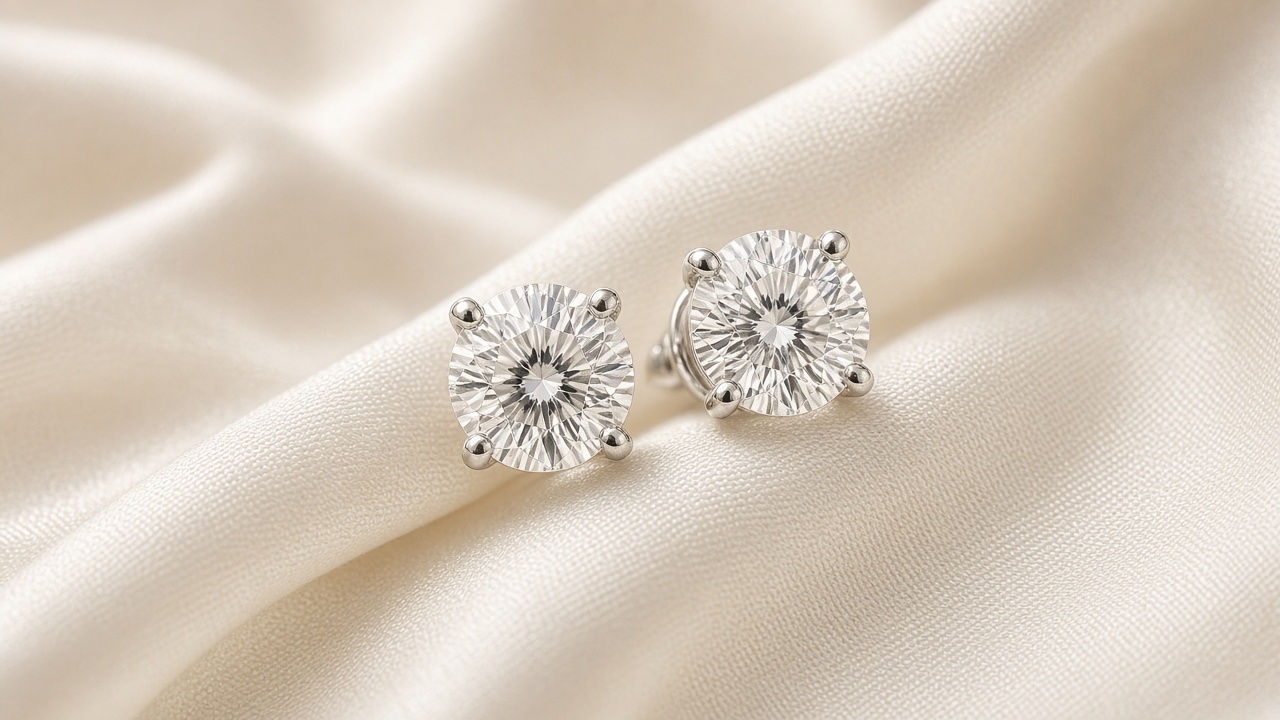
- Four-prong basket: the classic choice. Four small claws hold the stone squarely, give it a slightly square outline when viewed from the front, and offer good security.
- Three-prong martini: named for its V-shaped profile, it lets the stone sit close to the earlobe and exposes more of the diamond to light. With one fewer prong, it is worth having the prongs checked regularly.
- Six-prong: adds redundancy and gives a rounder outline, a good option for larger stones.
- Bezel: a thin rim of metal surrounds each diamond. It is sleek, modern and very protective, though it shows a little less of the stone.
- Halo: a ring of small diamonds around the center stone makes the earring look larger for the money.
Metal choice is mostly about style. White gold and platinum suit colorless diamonds, while yellow and rose gold feel warmer. GIA notes that 14K gold is 58.5% pure gold and 18K is 75%, while platinum alloys are usually 90 to 95% pure and, being denser, make the same setting feel heavier.
Pick the Right Back
The earring back is the part most likely to fail, so it deserves real attention:
- Push backs, also called butterfly or friction backs, slide onto the post. They are easy to use but can loosen over time.
- Screw backs thread onto a grooved post. They take a moment longer to fasten but are the most secure, which makes them a popular choice for larger or more valuable studs.
- Locking or secure backs click into place on a notched post and offer a middle ground between convenience and security.
Whichever you choose, check the backs regularly and replace any that feel loose. Larger stones also benefit from a back with a wider disc, which supports the earring so it does not tilt forward.
Natural or Lab-Grown?
Lab-grown diamond studs are now widely available. In 2018 the U.S. Federal Trade Commission revised its Jewelry Guides so that the definition of a diamond no longer depends on whether it was mined, while still requiring sellers to clearly disclose a lab-grown stone (FTC). Lab-grown diamonds usually let you buy more carat weight for the same budget, while natural diamonds appeal to buyers who value rarity. Either is a sound choice as long as the listing is clear about what you are getting.
For example, this 1.50 ct lab-grown diamond pair in 14K yellow gold martini settings shows how a three-prong setting keeps the stones close to the ear, while this 1.30 ctw round diamond pair in 14K yellow gold four-prong settings is a classic everyday size.
Designer Studs
If you want a signature look, several jewelry houses make their own takes on the stud. Hermès, for instance, offers the Finesse line, such as this Hermès Finesse diamond stud earring in 18K white gold. Designer pieces carry brand design and craftsmanship, and many shoppers find better value buying them pre-owned.
Caring for Diamond Studs
- Clean them gently with warm water, a drop of mild dish soap and a soft brush, then rinse and dry. Lotion and hair products dull diamonds quickly.
- Check the prongs and backs every few months, and have a jeweler inspect them once a year.
- Take them out for swimming, the gym and sleep, when backs are most likely to loosen.
- Store each pair in a soft-lined compartment so diamonds do not scratch other jewelry.
Shop Diamond Stud Earrings at TrueFacet
Diamond studs are a purchase you will wear for decades, so it pays to buy carefully. Browse our curated selection of diamond stud earrings and the wider earrings collection, all backed by our Authenticity Promise. Questions about a specific pair? Email our team at [email protected].